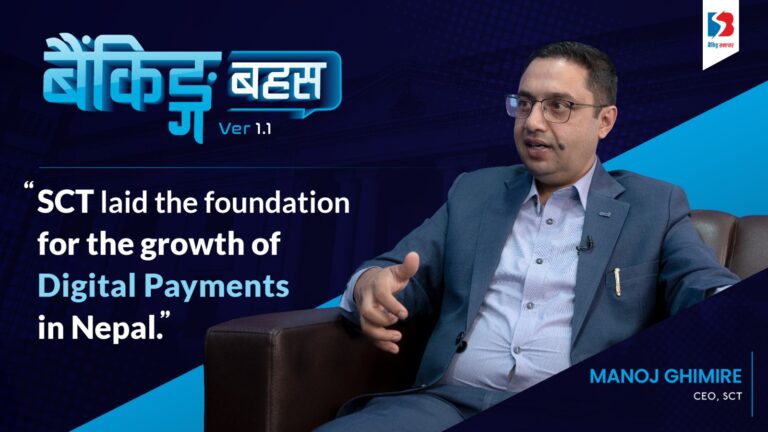

Banking News – Nepal has made remarkable progress in digital payments over the past two decades, but achieving a fully digital payment ecosystem remains a major challenge, according to Smart Choice Technologies (SCT) Chief Executive Officer Manoj Ghimire.
In an interview with Banking Bahas, Ghimire discussed Nepal’s economic outlook, the rapid growth of digital payments, challenges in lending, and the future of the country’s payment ecosystem.
Digital Payment Growth Outpaces the Economy
According to Ghimire, Nepal’s digital payment journey began in 2003 with the launch of Smart Choice Technologies (SCT), laying the foundation for the country’s digital financial ecosystem. Today, Nepal has 10 Payment System Operators (PSOs) and 27 Payment Service Providers (PSPs), while digital payment adoption has accelerated significantly over the past five years.
He said that although Nepal’s economy has been growing at an annual rate of only 3–4 percent, digital payment transactions have expanded at a much faster pace.
“Some digital payment instruments have recorded growth of as much as 3,000 percent,” Ghimire said. “Globally, the trend is moving toward paperless, cashless, automated payment systems, and Nepal is keeping pace with this transformation using world-class technologies.”
Cash Still Dominates Outside Major Cities
Despite the rapid increase in digital transactions, Ghimire noted that cash continues to dominate everyday payments, particularly outside Kathmandu.
“Digital payment usage is increasing in Kathmandu, but cash transactions remain the primary mode of payment in many urban areas beyond the capital,” he said.
He stressed that while the current growth rate is encouraging, Nepal should not be satisfied until digital payments become the preferred method of transaction nationwide.
Low Loan Demand Despite Excess Liquidity
Commenting on Nepal’s banking sector, Ghimire said banks currently have around NPR 1.3 trillion in excess liquidity and interest rates remain low, yet credit demand has not recovered.
He attributed this primarily to public attitudes toward borrowing.
“Our society is generally hesitant to take loans. Many people still believe borrowing is undesirable and are reluctant to invest through credit,” he said.
Although banks are willing to lend, he noted that borrowers who fail to repay loans ultimately face blacklisting, making both borrowers and lenders cautious, particularly in the small and medium enterprise (SME) sector.
Collateral-Free Loan Scheme Needs Stronger Infrastructure
Ghimire welcomed the Nepal Rastra Bank’s policy allowing collateral-free loans of up to NPR 1 million, saying it could greatly benefit small businesses. However, he questioned the operational framework supporting the policy.
According to him, Nepal currently lacks essential infrastructure such as a Central Know Your Customer (Central KYC) system that would allow customer verification to be shared among banks.
“If KYC completed at one bank could be accepted by another, the lending process would become much easier. However, Nepal is not yet ready to implement a Central KYC system,” he said.
He also stressed the need for an address verification mechanism, pointing out that recovering loans from borrowers living in rented accommodation remains a significant challenge.
Technical Service Providers Alone Are Not Enough
Responding to suggestions that Technical Service Providers (TSPs) could support collateral-free lending, Ghimire clarified that Technical Service Providers and billing service providers are different entities.
Although 11 billing software providers are currently registered with the Inland Revenue Department, he said these alone cannot provide a sufficient basis for approving unsecured loans.
Instead, he argued that a comprehensive customer verification system and reliable borrower identification mechanisms are necessary before large-scale collateral-free lending can be implemented safely.
NPR 1 Million Loan Facility Will Benefit Small Businesses
Despite these concerns, Ghimire believes the new loan policy will significantly support small and medium-sized entrepreneurs.
He said small business owners, such as grocery or vegetable shop operators renting commercial space, would benefit from easier access to financing, particularly when facing short-term cash flow shortages or seeking to expand their businesses.
Too Many Payment Companies for Nepal’s Market?
Asked whether Nepal needs 37 licensed payment companies, Ghimire said the market should ultimately determine the number of operators.
He noted that SCT is Nepal’s oldest digital payment company, but innovation can emerge from both established and new players.
However, considering Nepal’s population and transaction volume, he believes the current number of payment companies exceeds market requirements.
“Market demand and competition will naturally determine which companies survive,” he said, drawing a comparison with Nepal’s commercial banking sector, where the number of banks has declined through mergers and consolidation.
Not All Payment Companies Are Profitable
Regarding the financial health of payment companies, Ghimire estimated that around half of the Payment System Operators (PSOs) are profitable, while most Payment Service Providers (PSPs) generate only modest profits.
Licensing Policy Has Evolved Over Time
Commenting on Nepal Rastra Bank’s licensing approach, Ghimire explained that the central bank formally established its Payment Systems Department around 2015. Prior to that, several companies were already operating payment-related services.
When the licensing framework was introduced, those companies were officially registered under the new regulatory regime, leading to the growth of Nepal’s regulated digital payment industry.

 About Us
Comment